|
FOR IMMEDIATE RELEASE MEDIA CONTACTS
Journal of Science Policy & Governance André Porter communications@sciencepolicyjournal.org (202) 730-9502 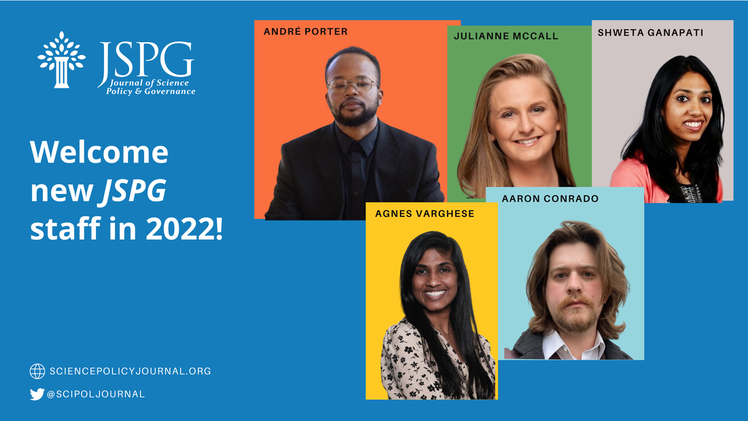 Washington, D.C. (March 14, 2022) — The Journal of Science Policy & Governance (JSPG) is pleased to welcome new members to its leadership team. The new staff will lead activities to increase the international visibility, reach, and impact of JSPG’s published work and events. Read the staff bios.
JSPG seeks to enhance the skills of young scholars in science and technology policy and governance through national and international partnerships, collaborations, and outreach. In 2022, the journal will continue its efforts to publish peer-reviewed articles on emerging, timely and relevant science, technology, and innovation policy topics while providing professional development opportunities for trainees and early career researchers in science policy. These include publishing special issues on science diplomacy, open science, and other areas, in addition to standard issues on a number of topics. The new staff members will work with the journal's partners to increase the impact and footprint of published work internationally and to enable published ideas to reach decision makers at all levels of government, in particular as we celebrate JSPG’s 10 year anniversary as an organization and move into the next decade of innovation in science policy. “I look forward to working with these talented science policy professionals at various stages in their careers, and to continue driving forward our mission of empowering and elevating the next generation of science policy leaders on international platforms,” says Adriana Bankston, JSPG’s CEO. ### About JSPG
The Journal of Science Policy & Governance is an internationally recognized, open-access peer-reviewed publication dedicated to elevating students, post-docs, policy fellows and young scholars in science, technology and innovation policy and governance debate worldwide. JSPG publishes high-quality articles covering the widest range of topics in formats that are accessible to policymakers. Since 2011, JSPG has served as a vehicle for students and early career researchers to bolster their research and writing credentials in science policy. Visit sciencepolicyjournal.org and follow on Twitter @SciPolJournal to learn more. FOR IMMEDIATE RELEASE  MEDIA CONTACTS
UNESCO Ana Persic a.persic@unesco.org + 33 (0) 1 45 68 17 00 MGCY Victoria Lovins VICTORIA.LOVINS@UNMGCY.ORG 352-262-7304 JOURNAL OF SCIENCE POLICY & GOVERNANCE Adriana Bankston abankston@sciencepolicyjournal.org 442-217-7434 WASHINGTON, DC (February 21, 2022) - The Journal of Science Policy & Governance (JSPG), the UN Educational, Scientific and Cultural Organization (UNESCO) and the Major Group for Children and Youth (MGCY) are pleased to announce a call for papers and competition on shaping the future of global scientific practices in the light of the COVID-19 pandemic, focused on Open Science Policies as an Accelerator for Achieving the Sustainable Development Goals. While the open science movement has gained significant momentum over the last several years, the COVID-19 pandemic has highlighted the need for increased access to scientific knowledge and fostering international scientific collaboration. It has also created opportunities for institutions and governments to develop tools needed for highlighting the crucial role of basic sciences for sustainable development. “Closed science models are at an impasse, because they amplify inequalities between countries and researchers, and because they only make scientific progress available to a minority. The health crisis has shown the incredible potential of scientific collaboration, which allowed us to sequence the genome of the COVID-19 virus so quickly,” said Audrey Azoulay, UNESCO Director-General. “The solidarity shown by the scientific community is a model for the future: in the face of global challenges, we need collective intelligence, today more than ever. As countries call for international scientific collaboration, as the scientific community, civil society, innovators and the private sector mobilize in these unprecedented times, the urgency of the transition to open science has never been more clear.” We invite students, post-doctoral researchers, policy fellows, early career researchers and young professionals from around the world to develop bold and innovative policy and governance ideas for exploring the untapped potential of open science to create a better society, and push for the attainment of the UN Agenda 2030 Sustainable Development Goals (SDGs). Submission deadline: July 10, 2022. The call for papers and competition will result in a Special Topics Issue of JSPG to be released in 2022. Authors of the top three publications will have the opportunity to present in UNESCO and MGCY events on open science. This Special Issue is supported in-kind by outreach partners from the Global Young Academy Open Science Working Group. “Open science, particularly in the wake of the COVID-19 pandemic, is critical to achieving the Sustainable Development Goals and to creating a more equitable global society. Young people, especially young scientists and engineers, have an important role to play in the process of open science policy creation and implementation because it is our lives and our careers that will be the most powerfully impacted by open science,” said Victoria Lovins, Co-Platform Coordinator, Science-Policy Interface, Major Group for Children and Youth (MGCY). Leading up to the submission deadline, JSPG will organize a series of training sessions to provide prospective authors with opportunities to practice policy writing for the Special Issue, and to inspire and empower them with expert perspectives on open science policies to inform their submissions. These events will include a science policy paper writing workshop on open science policy development, collaborative governance, scientific culture, and international cooperation, and a series of four webinars where content experts will discuss open science topics to be covered in the Special Issue. “The COVID-19 pandemic has highlighted the need for increased sharing of scientific knowledge and collaboration across the globe. Now more than ever, it is critical to break down barriers to accessing this knowledge across countries and within our local communities, and to build a common vision for a better society,” said Adriana Bankston, JSPG CEO and Managing Publisher. “JSPG is thrilled to partner with UNESCO and MGCY on this call for papers, and to incorporate the innovative policy ideas developed by the next generation into shaping the future of our society by leveraging the potential of open science.” ### About JSPG
The Journal of Science Policy & Governance is a nonprofit organization and open-access peer-reviewed publication managed by and for students, policy fellows and young scholars in science, technology and innovation policy. JSPG publishes high-quality articles covering the widest range of topics in formats that are accessible to policymakers. Since 2011, JSPG has served as a vehicle for students and early career researchers to bolster their research and writing credentials in science policy. Visit sciencepolicyjournal.org and follow on Twitter @SciPolJournal to learn more. About UNESCO Created in 1945, the United Nations Educational, Scientific and Cultural Organization (UNESCO) builds peace by fostering international cooperation in education, the sciences and culture. As the only specialized United Nations agency with an explicit mandate for science, UNESCO promotes international scientific cooperation, helps developing countries to build their scientific and technological capacity and supports Member States’ efforts to develop effective, inclusive public policies. The Organization’s work extends to standard-setting in its fields of competence. One of these standard-setting instruments is the UNESCO Recommendation on Open Science, adopted by 193 countries in November 2021. This Recommendation is the first international framework to provide guidelines on how to use open science to make science more equitable and inclusive. Visit https://en.unesco.org and follow on Twitter @UNESCO to learn more. About MGCY The Major Group for Children and Youth is the UN General Assembly-mandated and self-organized mechanism for young people to meaningfully engage in certain UN processes. MGCY acts as a bridge between young people and the UN system in order to ensure that their right to meaningful participation is realized. MGCY does so by engaging formal and informal communities of young people, in the design, implementation, monitoring, follow-up, and review of sustainable development policies at all levels of the UN system. Visit https://www.unmgcy.org and follow on Twitter @UNMGCY to learn more. About the GYA Working Group on Open Science Recognizing that open science fosters research communication that is inclusive, effective, and conducive to collaboration and discovery across fields and locations, the GYA working group on Open Science aims to inform current transformations in publication systems, institutions and technologies by (1) garnering and voicing young researchers’ views on which scientific outputs should be disseminated, how, to whom and with which expectations; (2) investigating the challenges and opportunities involved in implementing open science mandates across highly diverse research environments; (3) promoting open science mandates across the GYA membership and partner organizations. The Global Young Academy is an independent science academy of 200 outstanding early- to mid-career researchers from six continents who are selected from across disciplines based on their academic excellence and commitment to engage with society. The mission of the GYA is to give a voice to early-career researchers across the globe. Visit https://globalyoungacademy.net/activities/open-science/ and follow @GlobalYAcademy on Twitter to learn more. JSPG CEO speaks at NASEM Strategic Council for Research Excellence, Integrity, and Trust Meeting2/12/2022
 MEDIA CONTACT
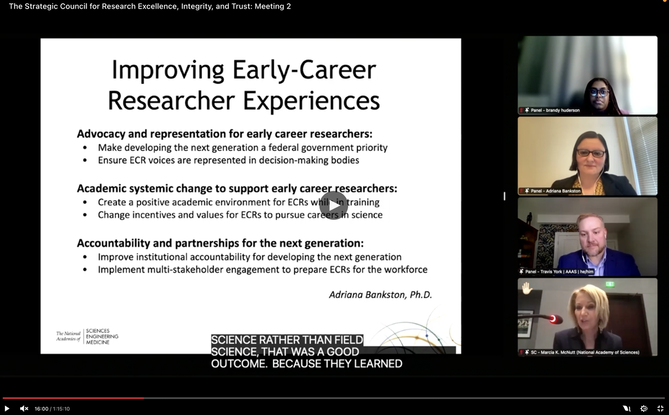
Journal of Science Policy & Governance André Porter communications@sciencepolicyjournal.org (202) 730-9502 Washington, DC (February 12, 2022) – JSPG CEO Dr. Adriana Bankston participated as a panelist in The National Academies of Science, Engineering, and Medicine (NASEM) Strategic Council for Research Excellence, Integrity, and Trust Meeting held earlier this week, alongside Dr. Travis York (AAAS) and Dr. Brandy Huderson (UDC & New Voices member). The panel was moderated by Dr. Marcia McNutt, president of the National Academy of Sciences & JSPG Advisory Board member. View the panel discussion here. Panelists discussed ideas to improve the early career research experience and provided insights into how the Strategic Council may be able to assist. The Strategic Council, co-chaired by Dr. David B. Allison, Dr. France Cordova and Dr. Marcia McNutt, serves as a venue for multiple stakeholders to advance collectively the integrity, ethics, resilience, and effectiveness of the research enterprise while at the same time preparing it for tomorrow's challenges. Learn more about the Strategic Council. ### About JSPG
The Journal of Science Policy & Governance (JSPG) is an international, open access peer-reviewed publication managed by and for students, policy fellows, and young scholars in science, technology, and innovation policy. JSPG publishes high-quality articles covering the widest range of topics in formats that are accessible to policymakers. Since 2011, JSPG has served as a vehicle for students and early career researchers to bolster their research and writing credentials in science policy. Visit sciencepolicyjournal.org and follow on Twitter @SciPolJournal to learn more. 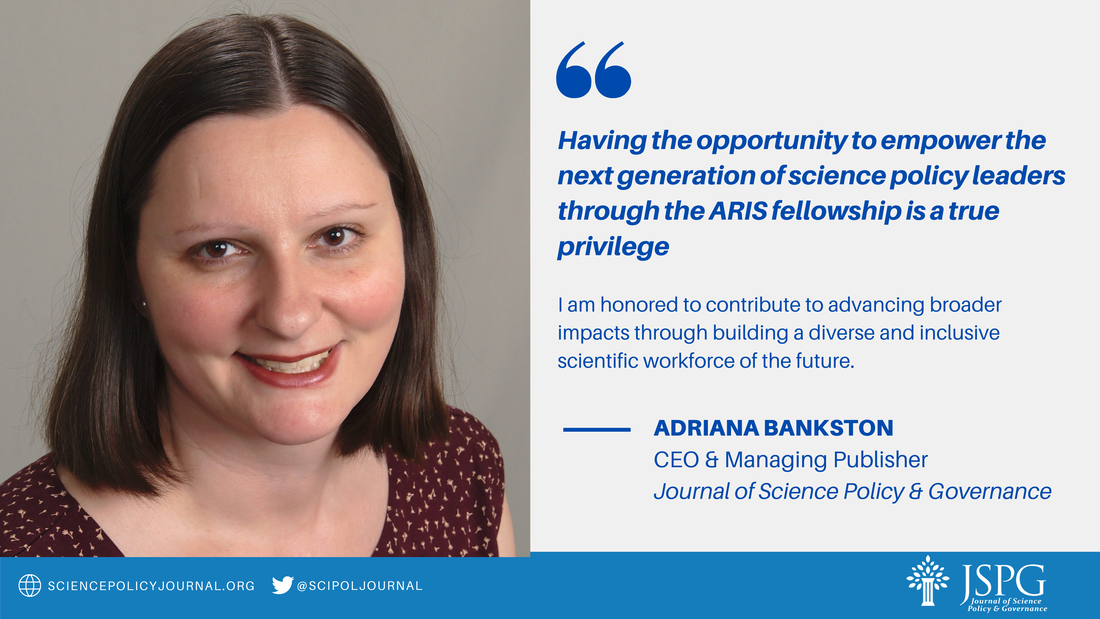 FOR IMMEDIATE RELEASE MEDIA CONTACTS
Adriana Bankston |
||||||||||||||||

|
| ||||
JSPG PARTNERS WITH AAAS S&T POLICY FELLOWSHIPS ON CALL FOR PAPERS FOR 2022 SUMMER STANDARD ISSUE
1/31/2022
Kat Song
ksong@aaas.org
(202) 326-6614
Adriana Bankston
abankston@sciencepolicyjournal.org
(442) 217-7434
Training the Next Generation of Leaders in Science and Technology Policy
With the Journal of Science Policy & Governance
In the midst of a global pandemic, evidence-based policymaking is critical for our future, and the views of the next generation in shaping the policy landscape are more important now than ever. We invite students, postdocs, policy fellows, early career researchers, and young professionals in science policy to contribute their ideas on the future of policymaking on a number of broad topics that address important societal challenges. Submission deadline: May 22, 2022.
The partnership helps JSPG and STPF advance a shared mission of developing the next generation of leaders in science and technology policy and enabling them to develop and execute relevant and timely policy solutions. Hosted at the world’s largest multidisciplinary scientific society, the AAAS STPF program has engaged thousands of scientists and engineers to contribute first-hand to the policymaking process via yearlong fellowships in the Federal government. As part of this mission, JSPG fosters training and professional development of the next generation through publishing early career work in science policy in a variety of formats, and elevating the ideas put forth in publications through international platforms.
“The importance of early career contributions to evidence-based policy cannot be overstated. As an organization that elevates early career voices, JSPG is thrilled to partner with AAAS STPF on this standard issue, which seeks to bring the ideas of the next generation to the forefront and provide them with the educational tools needed to put these ideas into action,” said Adriana Bankston, JSPG CEO & Managing Publisher.
The Journal of Science Policy & Governance (JSPG) is a nonprofit organization and open access peer-reviewed publication managed by and for students, policy fellows, and young scholars in science, technology, and innovation policy. Since 2011, JSPG has served as a vehicle for students and early career researchers to bolster their research and writing credentials in science policy. Visit sciencepolicyjournal.org and follow on Twitter @SciPolJournal to learn more.
ABOUT AAAS S&T POLICY FELLOWSHIPS
AAAS Science & Technology Policy Fellowships (STPF) provide opportunities to outstanding scientists and engineers to learn first-hand about policymaking and contribute their knowledge and analytical skills in the policy realm. Fellows serve yearlong assignments in the Federal government and represent a broad range of backgrounds, disciplines, and career stages. Each year, STPF adds to a growing corps of nearly 4,000 fellowship alumni. STPF alumni are policy-savvy leaders working across academia, government, nonprofits, and industry to serve the nation and citizens around the world. Visit the STPF website at AAAS.org/STPF and follow @AAAS_STPF on Twitter to learn more.
SAHEEL MEHTA
COMMUNICATIONS@SCIENCEPOLICYJOURNAL.ORG
(434) 202-4232
JSPG and UCL STEaPP Launch 2022 Call for Papers and Competition on Innovations in Science Diplomacy: Structures, Policies & Governance for the New Decade
“As we reflect on the essential role that young people play in international science diplomacy, JSPG and UCL STEaPP are thrilled to launch this call for papers and competition facilitating substantial engagement of the next generation in shaping the future the field for a better global society in the next decade and beyond,” said Adriana Bankston, JSPG CEO and Managing Publisher.
Following submission review via the JSPG editorial review process, a competition review committee will select the top 3 publications. Authors of the top 3 articles will be invited to present at a dedicated science diplomacy event featuring science diplomacy representatives of different countries and international organizations in Fall 2022.
JSPG and UCL STEaPP will organize 2 webinars with expert perspectives on science diplomacy, and a policy writing workshop to help prospective authors improve their submissions to the issue. The events will be co-organized with and include participants from outreach partner organizations. Register for the events here.
"Many of the challenging global issues of our times are underpinned by STI, and require evidence-informed, multi-stakeholder and transdisciplinary approaches. UCL STEaPP and JSPG look forward to emerging scholars and young leaders’ fresh look and innovative ideas which are key to building better science diplomacy interfaces, governance structures and global policies,” said Joanna Chataway, Professor and Head of Department of Science Technology, Engineering & Public Policy, University College London.
The Journal of Science Policy & Governance is a nonprofit organization and open-access peer-reviewed publication managed by and for students, policy fellows and young scholars in science, technology and innovation policy. JSPG publishes high-quality articles covering the widest range of topics in formats that are accessible to policymakers. Since 2011, JSPG has served as a vehicle for students and early career researchers to bolster their research and writing credentials in science policy. Visit sciencepolicyjournal.org and follow on Twitter @SciPolJournal to learn more.
About UCL STEaPP
The Department of Science, Technology, Engineering and Public Policy (STEaPP) is part of the Faculty of Engineering Sciences at University College London. Its research encompasses several policy issues, including digital technology policy, urban and infrastructure policy, and energy and sustainability policy. It also focuses on science advice to governments, expertise in international organizations and science diplomacy. Its vision is to transform, through strong partnerships and communities, the relationship between science, technology, engineering, and public policy to ensure that new knowledge fully benefits society. Visit https://www.ucl.ac.uk/steapp/ and follow @UCLSTEaPP on Twitter to learn more.
About INGSA
The International Network for Government Science Advice (INGSA) is the leading global platform for policy exchange, capacity building, research and collaboration on the mechanisms and practices at the evidence-to-policy interface. Through workshops, conferences and a catalogue of tools and guidance, the network helps structure and strengthen these social, political and scientific interactions to improve the potential for evidence-informed policy formation at sub-national, national and transnational levels. Visit https://www.ingsa.org and follow @INGSciAdvice on Twitter to learn more.
About the European Union (EU) Science Diplomacy Alliance
The EU Science Diplomacy Alliance is a collaborative initiative launched in 2020 by a group of EU-funded science diplomacy projects to sustain and grow the networks, impact and momentum. The activities of the Alliance aim to further develop, maintain, and organise joint research projects, capacity building and training activities (such as open online courses, summer schools, trainings, etc.) on the topic of science diplomacy. Visit https://www.science-diplomacy.eu and follow @SciDipAlliance on Twitter to learn more.
About the GYA Incubator Group on Science Diplomacy in the Americas
Recognizing the gaps in scientific development and collaborations between North America, Central America, South America, the Caribbean, and Commonwealth countries, the Global Young Academy (GYA) Incubator Group on Science Diplomacy in the Americas aims to promote openness to scientific partnerships and to gain an understanding of current science diplomacy initiatives in the region. The Global Young Academy is an independent science academy of 200 outstanding early- to mid-career researchers from six continents who are selected from across disciplines based on their academic excellence and commitment to engage with society. The mission of the GYA is to provide a voice to early-career researchers across the globe. Visit https://globalyoungacademy.net/activities/science-diplomacy-in-the-americas/ and follow @GlobalYAcademy on Twitter to learn more.
JSPG Celebrates a Decade as a Publishing Leader in Science, Technology, and Innovation Policy
|
"This issue demonstrates the true breadth of expertise reflected in our authors at JSPG. I am particularly proud of how the authors have leveraged a critical eye to examine policy through the lens of environmental, health, regulatory and social justice needs,” said Ben Wolfson, JSPG Assistant Editor-in-Chief for Standard Editions. “Following in the precedents established by JSPG’s first standard issue, our authors continue to interrogate the impacts of science policy from university regulations to making policy recommendations addressing broad subjects such as regenerative agriculture and power grid resilience."
|

Ben Wolfson, Assistant Editor-In-Chief, Standard Editions
|
|
|
Similarly, 10 years ago, the first standard issue of JSPG had 7 outstanding articles addressing environmental policy areas such as reducing demand on groundwater sources and ocean acidification; health-related topics including research outputs related to Environmental, Health, & Safety, and the need for diversity in clinical trials; and ways to reform institutional infrastructures and incentives to fulfill our national objectives in research and highlight societal benefits of university research.
|
|
To reflect on these topics, JSPG’s Editor-in-Chief Rosie Dutt and CEO & Managing Publisher Adriana Bankston have co-authored a cover memo focused on empowering the next generation to leverage their innovative ideas published in the journal to make a positive impact in society today and into the future.
|

Rosie Dutt, Editor-in-Chief
|

Adriana Bankston, CEO & Managing Publisher
|
The Journal of Science Policy & Governance (JSPG) is a nonprofit organization and open-access peer-reviewed publication managed by and for students, policy fellows and young scholars in science, technology and innovation policy. JSPG publishes high-quality articles covering the widest range of topics in formats that are accessible to policymakers. Since 2011, JSPG has served as a vehicle for students and early career researchers to bolster their research and writing credentials in science policy. Visit sciencepolicyjournal.org and follow on Twitter @SciPolJournal to learn more.
This special issue raises awareness of science policy topics that directly affect marginalized scientists and communities, and provides possible solutions by which to increase diversity, equity and inclusion in science policy as laid out by the next generation of leaders in the field.
“The rewards and successes of scientific discovery have been limited by a failure to consider science’s intersection with diversity, equity, inclusion and social justice. To progress in science, we must represent all intersections of diversity in scientific effort and knowledge, evaluate research structures with an equitable and inclusive lens, and advance research in support of social and environmental justice,” said Emily Pinckney, Executive Director, 500 Women Scientists; Tiffany G. Harrison, Director, Public Policy Special Interest Group, National Society of Black Engineers (NSBE) & Pamela A. Padilla, President, Society for Advancement of Chicanos/Hispanics and Native Americans in Science (SACNAS) in the cover memo for this issue.
Winning memos are as follows:
- First place - Bridging The Gap: Demanding 1-1 Representation of Dark-Light Skin Tones Within Medical Lectures/Resources
- Second place- Algorithm Transparency through the Fair Credit Reporting Act (FCRA)
- Third place (tie) - Addressing Racial Disparities in NIH Funding & Motor Vehicle Crash Testing Regulations for More Inclusive Populations
Honorable mentions:
- Expanding Access to and Ensuring Equity in the Benefits of Remote Work Following the COVID-19 Pandemic
- Period Poverty: A risk factor for people who menstruate in STEM
- Decolonization of STEM in the Public Education System in Québec, Canada
“This special issue addresses important societal problems in education, work, health, the environment, and other areas, and provides policy solutions centered on diversity, equity, inclusion and social justice. We hope this issue will encourage early career scientists from backgrounds traditionally excluded from science policy conversations, to bring their ideas forward and contribute to international policy debates,” says Adriana Bankston, CEO of JSPG.
This special issue is also supported in-kind by the Society for Advancement of Chicanos/Hispanics and Native Americans in Science (SACNAS), 500 Women Scientists and the National Society of Black Engineers (NSBE). JSPG and NSPN partnered with these organizations in a series of writing workshops to provide prospective authors with the skills needed to write effective policy memos on DEI topics.
The Journal of Science Policy & Governance is a nonprofit organization and open-access peer-reviewed publication managed by and for students, policy fellows and young scholars in science, technology and innovation policy. JSPG publishes high-quality articles covering the widest range of topics in formats that are accessible to policymakers. Since 2011, JSPG has served as a vehicle for students and early career researchers to bolster their research and writing credentials in science policy. Visit sciencepolicyjournal.org and follow on Twitter @SciPolJournal to learn more.
The National Science Policy Network (NSPN) is a grassroots, member-based organization that catalyzes the engagement of early career scientists and engineers in policy making by fostering an inclusive community, training new generations of diverse leaders, and empowering advocates for the role of science in society. In addition to the policy memo competition in collaboration with JSPG, NSPN supports a variety of other activities, including grants, internships, externships and their annual National Science Policy Symposium. Visit scipolnetwork.org and follow on Twitter @SciPolNetwork to learn more.
About SACNAS
Society for Advancement of Chicanos/Hispanics and Native Americans in Science (SACNAS) is an inclusive organization dedicated to fostering the success of Chicanos/Hispanics and Native Americans, from college students to professionals, in attaining advanced degrees, careers and positions of leadership in STEM. Visit sacnas.org and follow on Twitter @sacnas to learn more.
About 500 Women Scientists
500 Women Scientists is a grassroots organization committed to speaking up for science and for marginalized communities in science, as well as confronting the shameful history of science being used to harm people - and the participation of the scientific community in this harm. More than 20,000 women of STEM and supporters from more than 100 countries have signed in support of 500 Women Scientists, pledging to build an inclusive scientific community dedicated to training a more diverse group of future leaders in science and to use the language of science to bridge divides and enhance global diplomacy. Visit 500womenscientists.org and follow on Twitter @500womensci to learn more.
About NSBE
With more than 700 chapters and more than 21,000 active members in the U.S. and abroad, the National Society of Black Engineers (NSBE) is one of the largest student-governed organizations based in the United States. NSBE, founded in 1975, supports and promotes the aspirations of collegiate and pre-collegiate students and technical professionals in engineering and technology. NSBE’s mission is “to increase the number of culturally responsible Black engineers who excel academically, succeed professionally and positively impact the community.” Visit nsbe.org and follow on Twitter @NSBE to learn more.
SIGMA XI
JPAPAGAN@SIGMAXI.ORG
(919) 518-7820
JOURNAL OF SCIENCE POLICY & GOVERNANCE
COMMUNICATIONS@SCIENCEPOLICYJOURNAL.ORG
(434) 202-4232
JSPG and Sigma Xi Launch 2022 Call for Papers and Competition on Re-envisioning STEM Education and Workforce Development for the 21st Century
We invite students, post-docs, policy fellows, and early career professionals worldwide to submit op-eds and policy position papers to re-envision the landscape of STEM education and workforce development in the light of the COVID-19 pandemic, and to build forward a future that is focused on equity and inclusion, access to technology, and aligning training opportunities with workforce demands.
The call for papers and competition for op-eds and policy position papers will result in a Special Topics Issue of JSPG to be released in 2022 that will comprise the most compelling papers. Authors of the top three publications will receive cash prizes.
“The COVID-19 pandemic has exposed and exacerbated educational inadequacies and inequities for students pursuing STEM careers. This partnership with JSPG will harness the knowledge and experience of emerging leaders to help build more equitable and effective education and training programs,” said Jamie Vernon, Executive Director and CEO of Sigma Xi and publisher of American Scientist magazine.
This Special Topics Issue is also supported in-kind by outreach partners from STEM Education Coalition, Albert Einstein Distinguished Educator Fellowship Program, MSI STEM Research & Development Consortium, Duke Science & Society and Science is US, whose contributions will elevate the policy ideas in STEM education and workforce development put forth by the next generation across national and international platforms.
The Journal of Science Policy & Governance is a nonprofit organization and open-access peer-reviewed publication managed by and for students, policy fellows and young scholars in science, technology and innovation policy. JSPG publishes high-quality articles covering the widest range of topics in formats that are accessible to policymakers. Since 2011, JSPG has served as a vehicle for students and early career researchers to bolster their research and writing credentials in science policy. Visit sciencepolicyjournal.org and follow on Twitter @SciPolJournal to learn more.
About Sigma Xi
Sigma Xi, The Scientific Research Honor Society, founded in 1886, is the world’s largest multidisciplinary honor society exclusively for scientists and engineers. The Society’s mission is to enhance the health of the research enterprise, foster integrity in science and engineering, and promote the public understanding of science for the purpose of improving the human condition. Over 500 Sigma Xi chapters can be found wherever scientific research is undertaken at colleges, universities, government laboratories, and industry research centers worldwide. Among our 100,000 inductees, more than 200 are Nobel Prize winners. The Society is based in the Research Triangle Park, North Carolina. Visit sigmaxi.org and follow on Twitter @SigmaXiSociety to learn more.
|
Saheel Mehta
Journal of Science Policy & Governance communications@sciencepolicyjournal.org (434) 202-4232 |
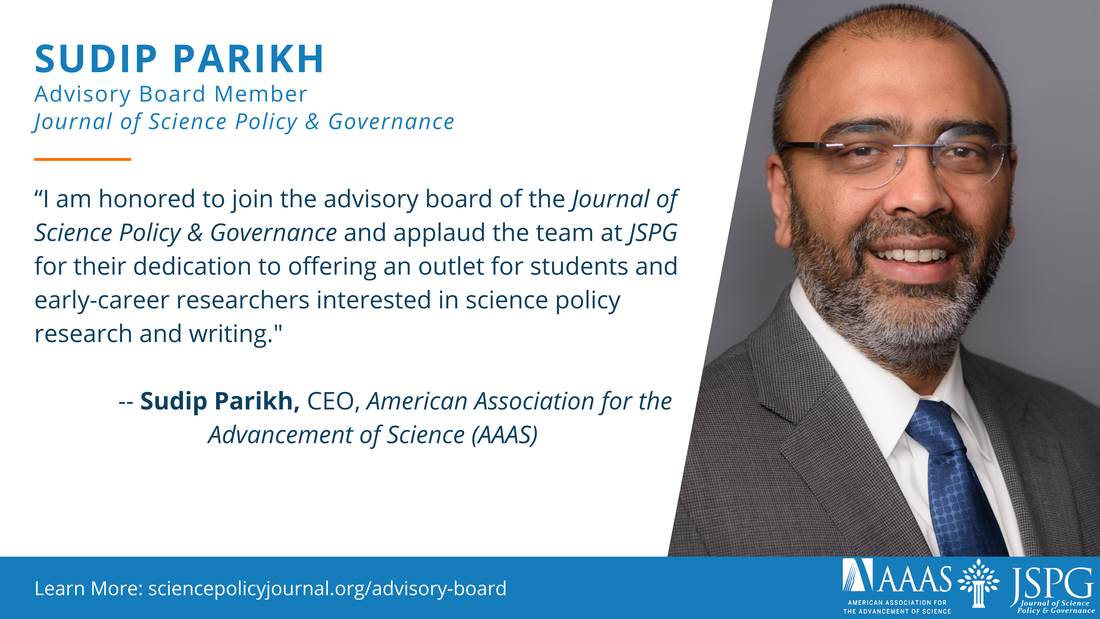
Sudip Parikh joins the JSPG advisory board alongside other distinguished leaders who have been at the forefront of science policy for many years and in many cases have defined the field as we know it today. We are grateful for their continued guidance and expertise as we enter the next decade of innovation for the journal. Read more about Sudip Parikh here.
The Journal of Science Policy & Governance (JSPG) is a nonprofit organization and open-access peer- reviewed publication managed by and for students, policy fellows, and young scholars in science, technology, and innovation policy. Since 2011, JSPG has served as a vehicle for students and early career researchers to bolster their research and writing credentials in science policy. Visit sciencepolicyjournal.org and follow on Twitter @SciPolJournal to learn more.
The American Association for the Advancement of Science (AAAS) is the world’s largest general scientific society and publisher of the journal Science, as well as Science Translational Medicine; Science Signaling; a digital, open-access journal, Science Advances; Science Immunology; and Science Robotics. AAAS was founded in 1848 and includes more than 250 affiliated societies and academies of science, serving 10 million individuals. Science has the largest paid circulation of any peer-reviewed general science journal in the world. The nonprofit AAAS is open to all and fulfills its mission to “advance science and serve society” through initiatives in science policy, international programs, science education, public engagement, and more. For additional information about AAAS, see aaas.org.
JSPG News
All the latest news from the Journal of Science Policy & Governance.
Follow JSPG on Twitter, Facebook, LinkedIn, Instagram, and YouTube.
Join our monthly newsletter.
Archives
April 2024
March 2024
October 2023
September 2023
July 2023
June 2023
April 2023
March 2023
January 2023
December 2022
October 2022
September 2022
August 2022
July 2022
June 2022
May 2022
April 2022
March 2022
February 2022
January 2022
November 2021
September 2021
August 2021
July 2021
June 2021
April 2021
January 2021
December 2020
October 2020
September 2020
August 2020
July 2020
June 2020
May 2020
April 2020
February 2020
December 2019
November 2019
September 2019
August 2019
April 2019
March 2019
February 2019
January 2019
November 2018
October 2018
September 2018
April 2018
February 2018
December 2017
Categories
All
Advisory-board
Ambassador
Ambassador Spotlight
Ambassador Spotlight Series
Announcement
Award
Blog
Climate
Diplomacy
Editor
Environment
Event
Fellow
Governing Board
JSPG10
News
Open Science
Partnership
Policy
Policy Memo Competition
Press Release
Special Issue
Sponsorship
Staff
Summer Standard Issue
Sustainable Development
Volume Release
Webinar
Winter Standard Issue
 RSS Feed